by Laura Gilroy
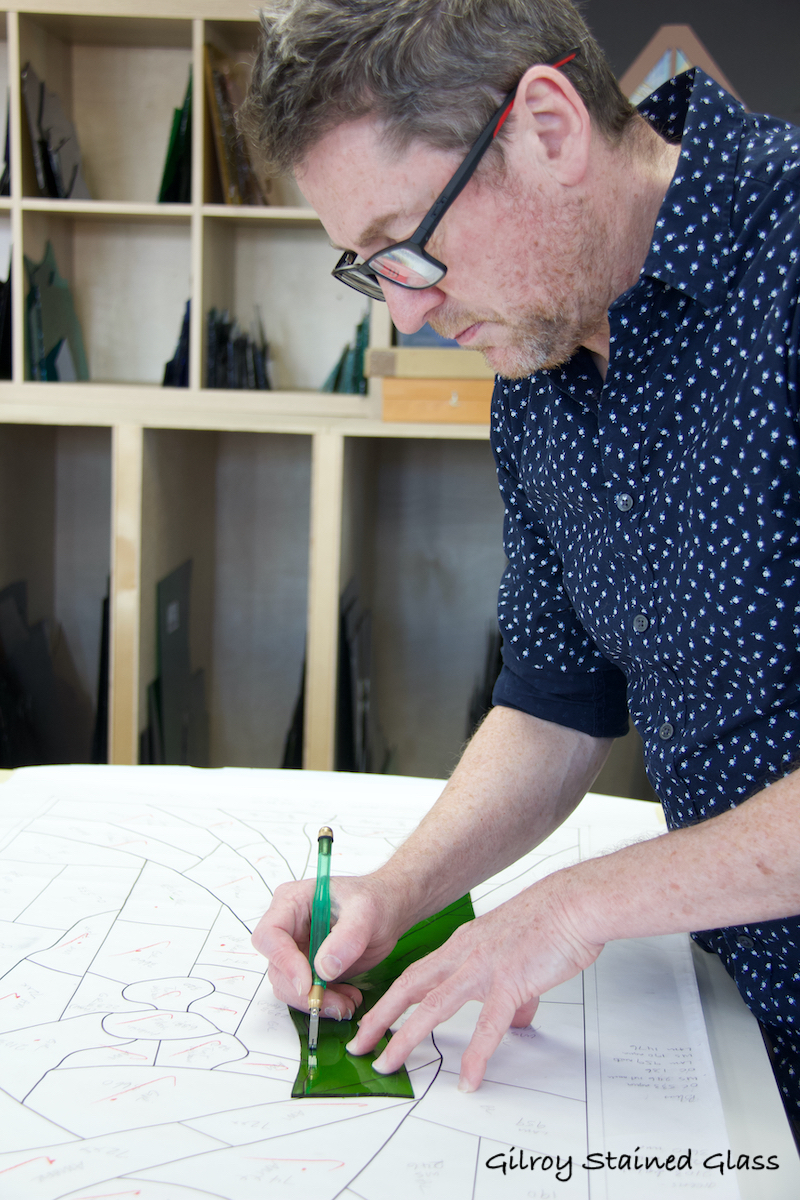
We’ve recently received our Fall issue of the Stained Glass Association of America magazine which features an article about our mentor Roy Coomber and an article about our studio and the work we’ve done here in Vancouver.
Here’s a copy of the article if you want a little coffee time read;
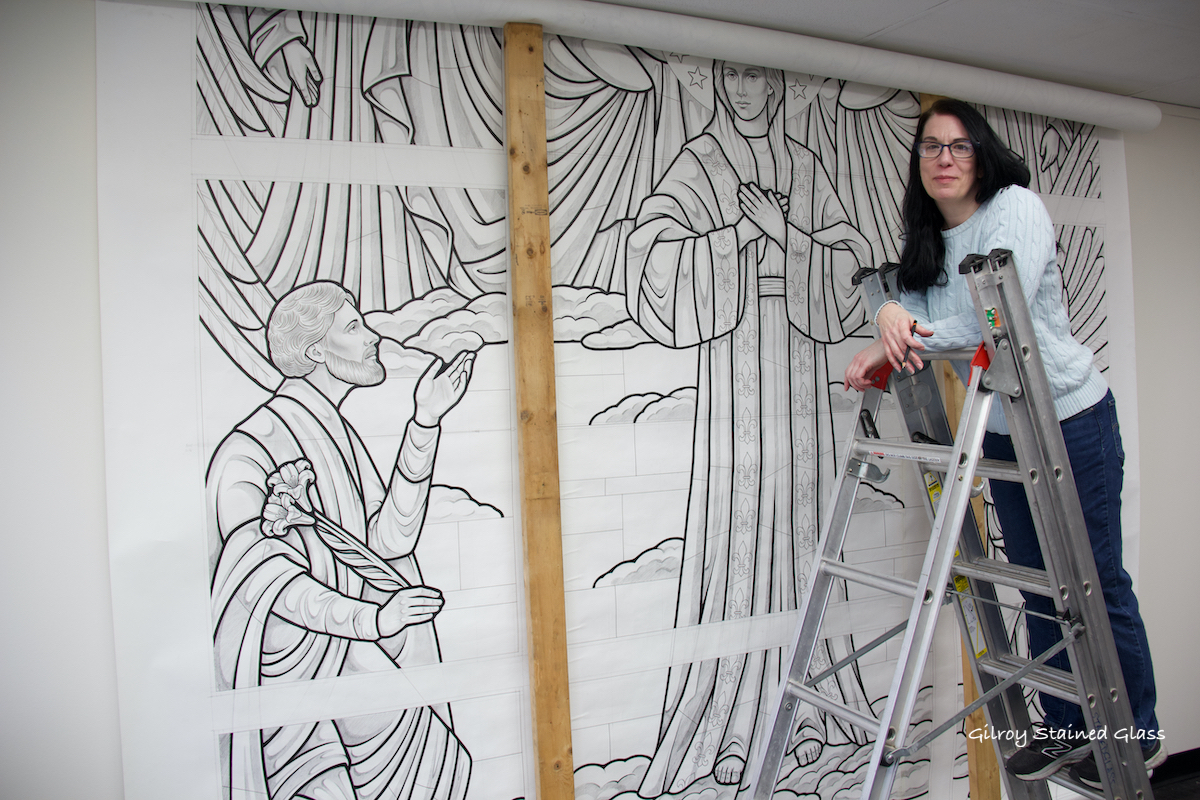
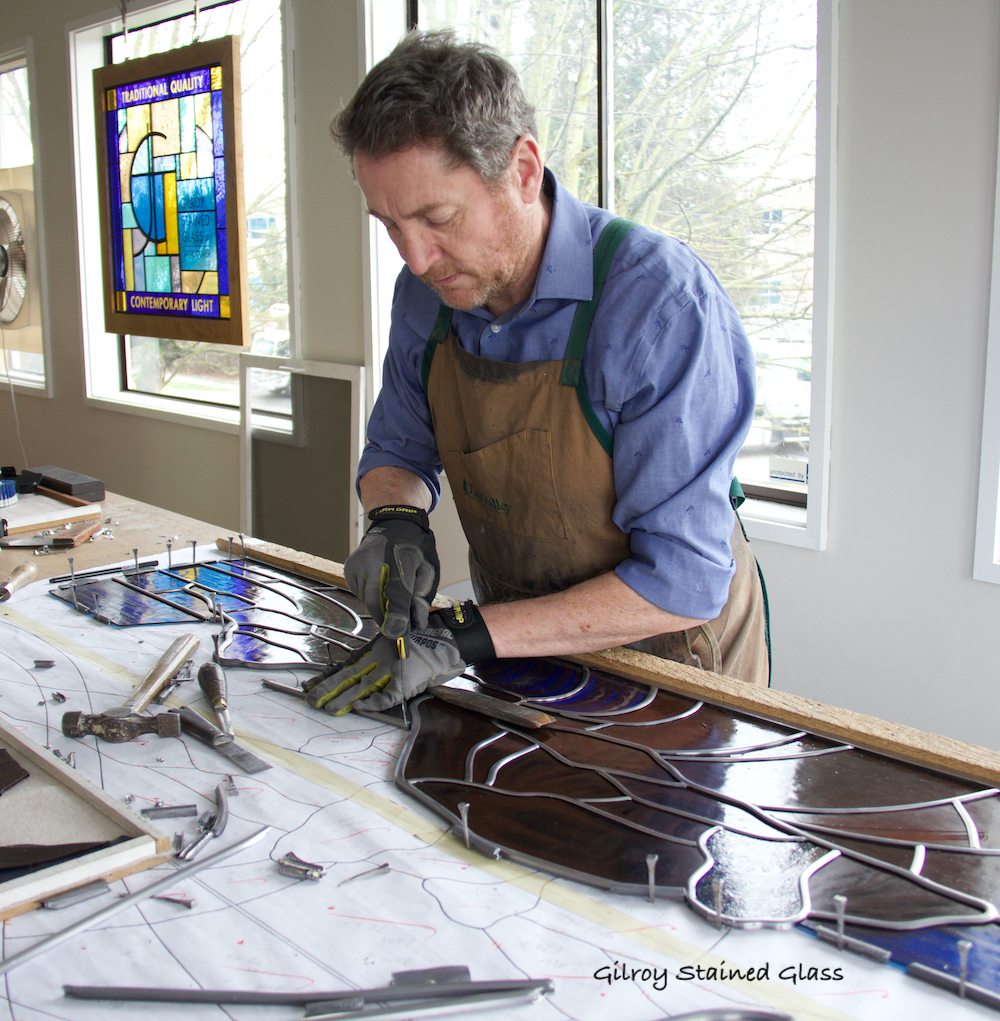
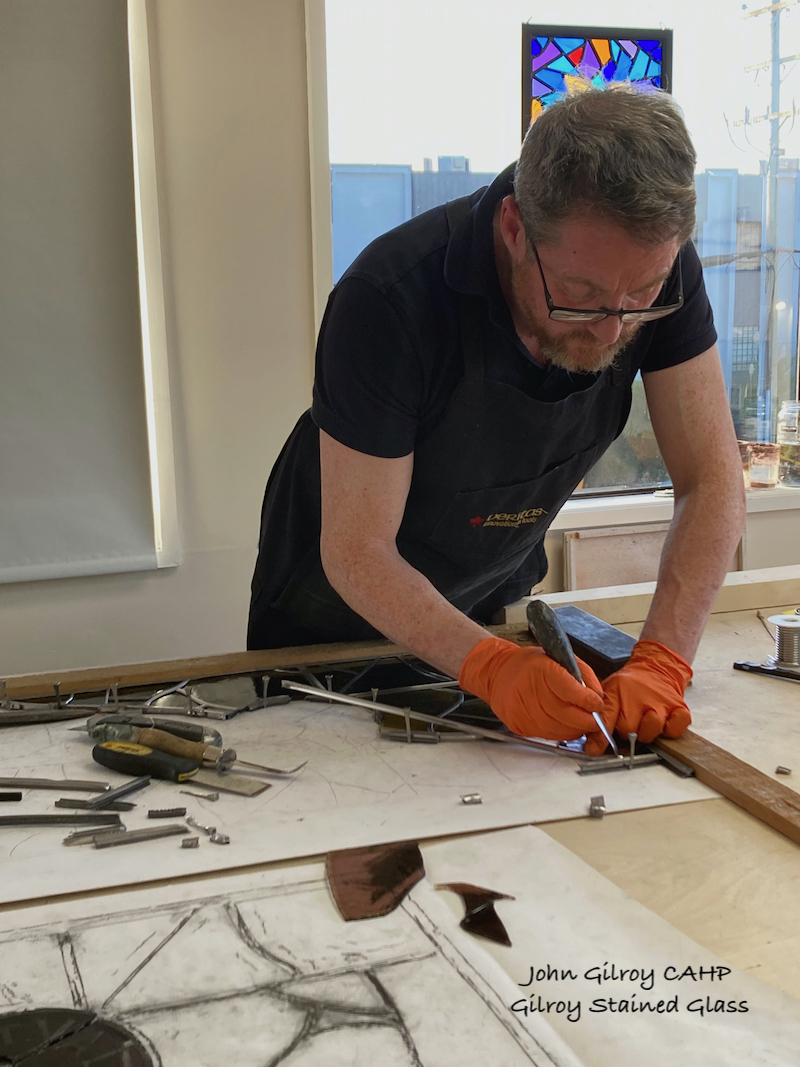
“John and Laura Gilroy have been involved in producing stained glass since 1985 when they began an intensive apprentice education in one of England’s oldest studios founded in 1788. There they mastered the traditional skills used in creating new windows and in the preservation and restoration of existing windows.
This type of training, with skilled and experienced artists teaching younger artists, is unfortunately very rare now that many of the large and long established studios have closed. The Gilroys consider themselves fortunate to have been the last artists to have completed their training before James, Clark and Eaton of Bristol closed their doors for the last time. John spent his entire apprenticeship there, primarily trained by Roy Coomber FMGP SGAA, while Laura continued her education with Roy when he left to establish his own studio; “we appreciated his willingness to share his knowledge and to give constructive criticism, and we admired his enthusiasm to try different techniques in the medium and to keep his art ‘fresh’ even after so many years in the business.”
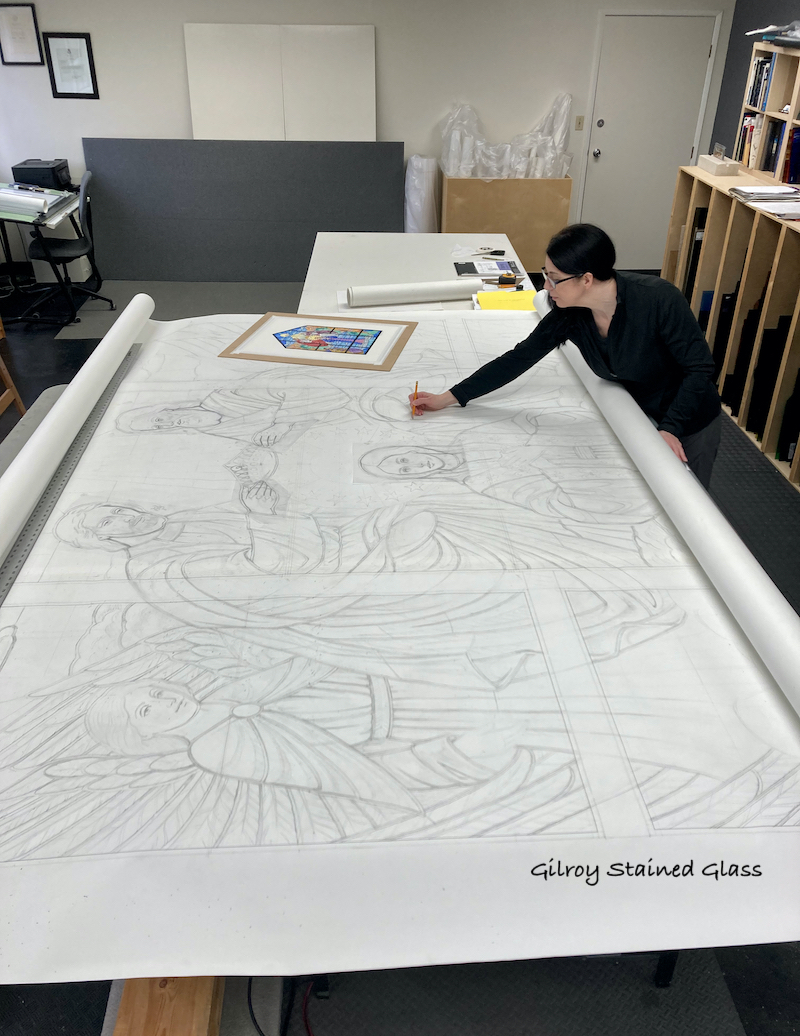
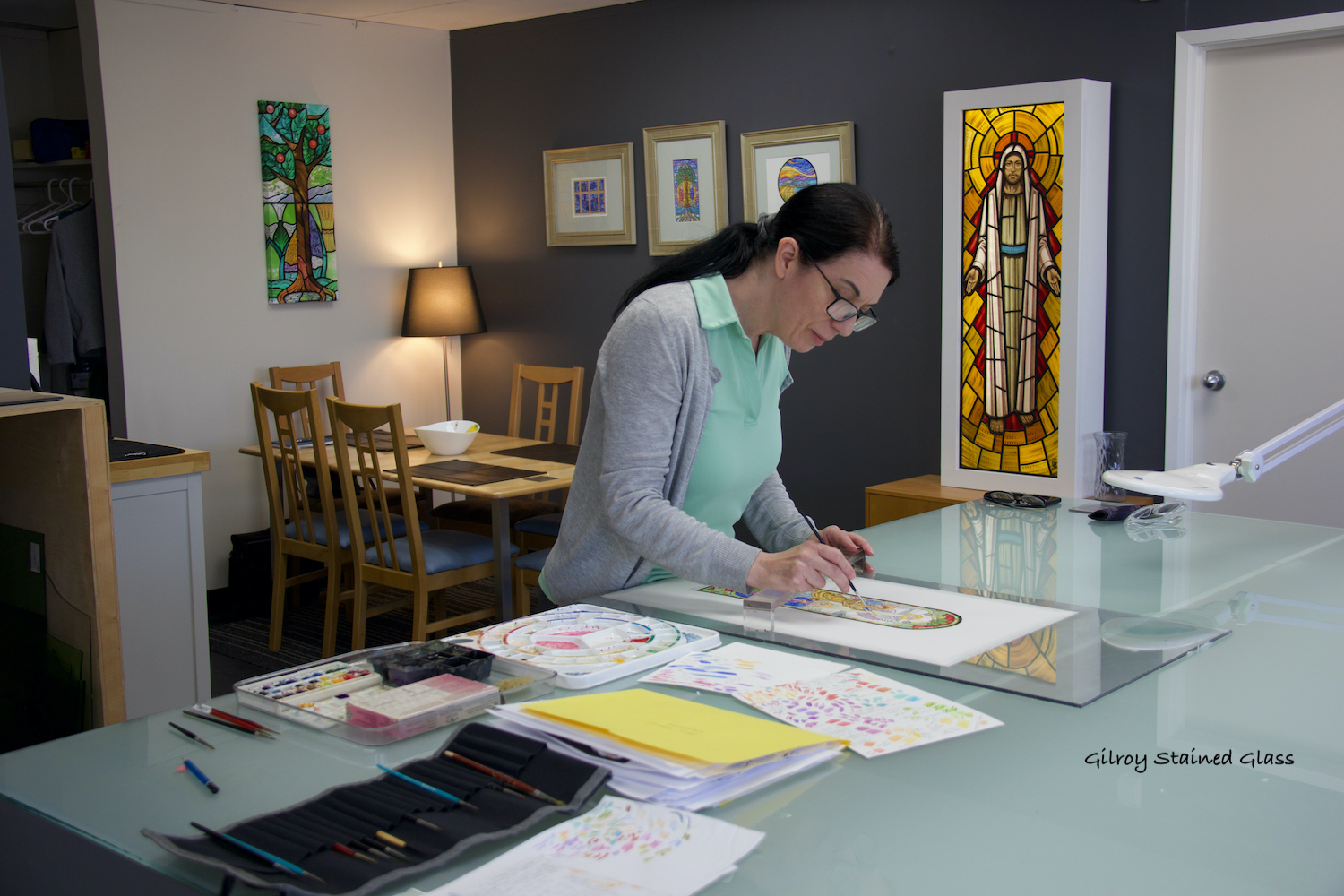
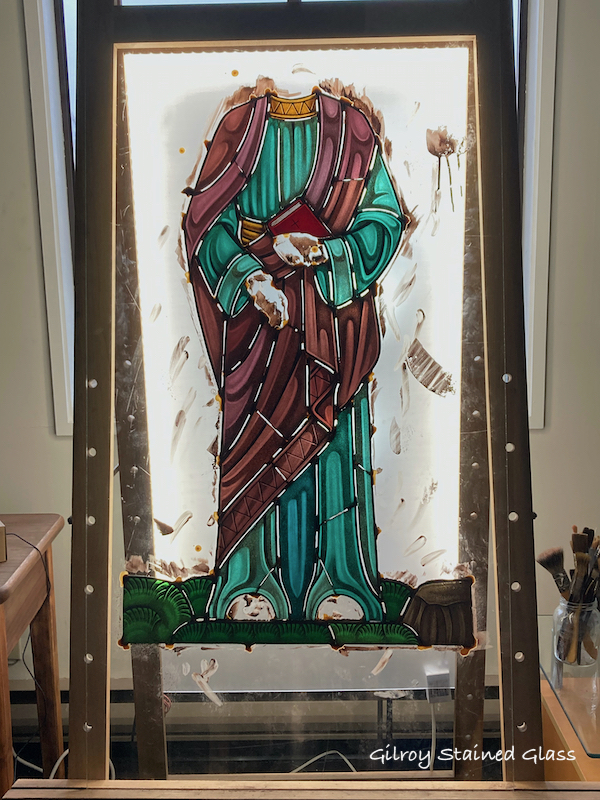
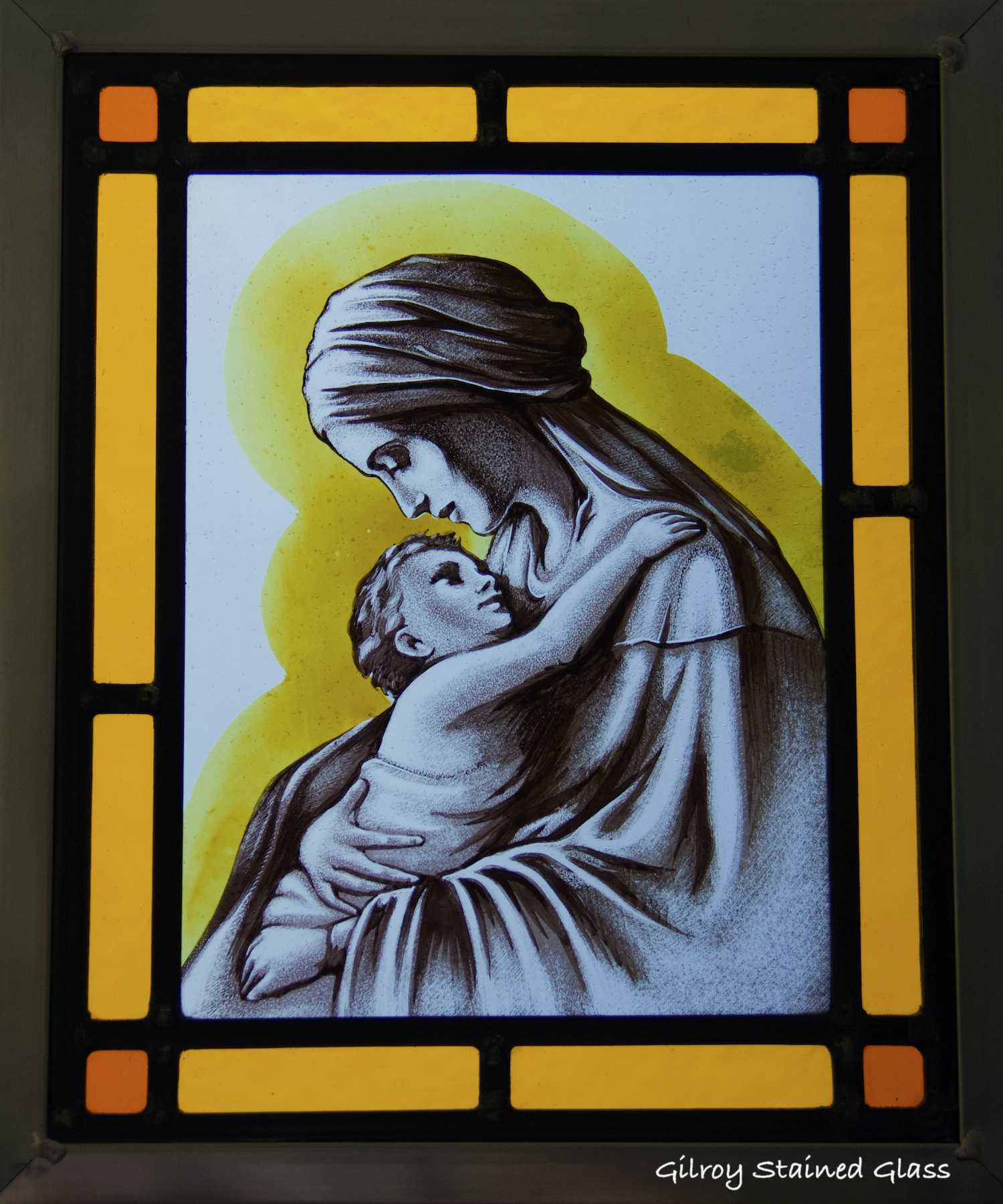
The focus was glass painting - learning to create structure through line, and tonal values through contrast of light and shade, then learning to recreate and match many different styles for restoration, and progressing to painting new windows as well as cartooning and designing. Another influence was the late Dorothy and James Crombie ARCA, AMGP “whose abilities, knowledge and encouragement played a significant part in giving us a passion for the unique and demanding medium of stained glass”.
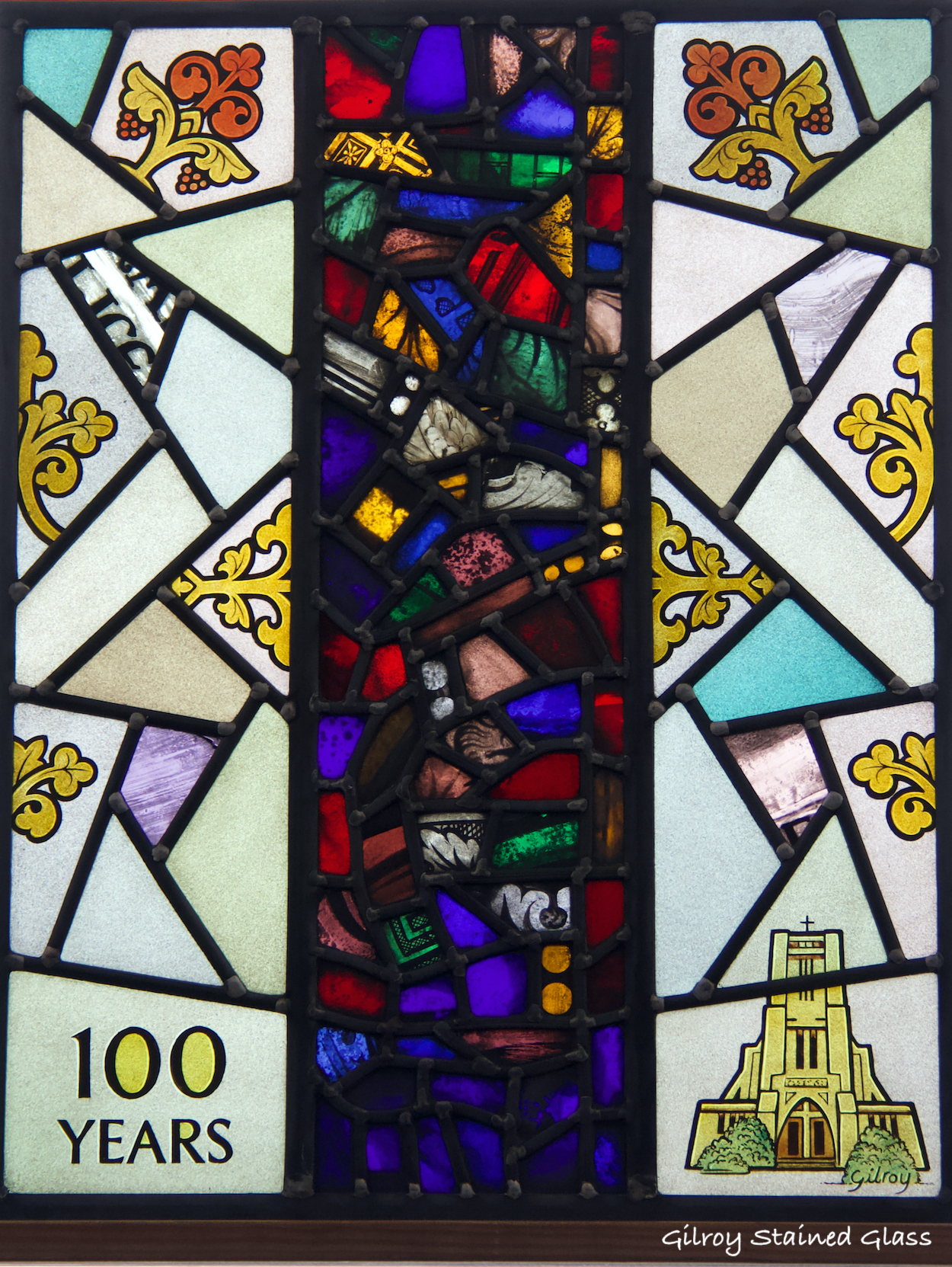
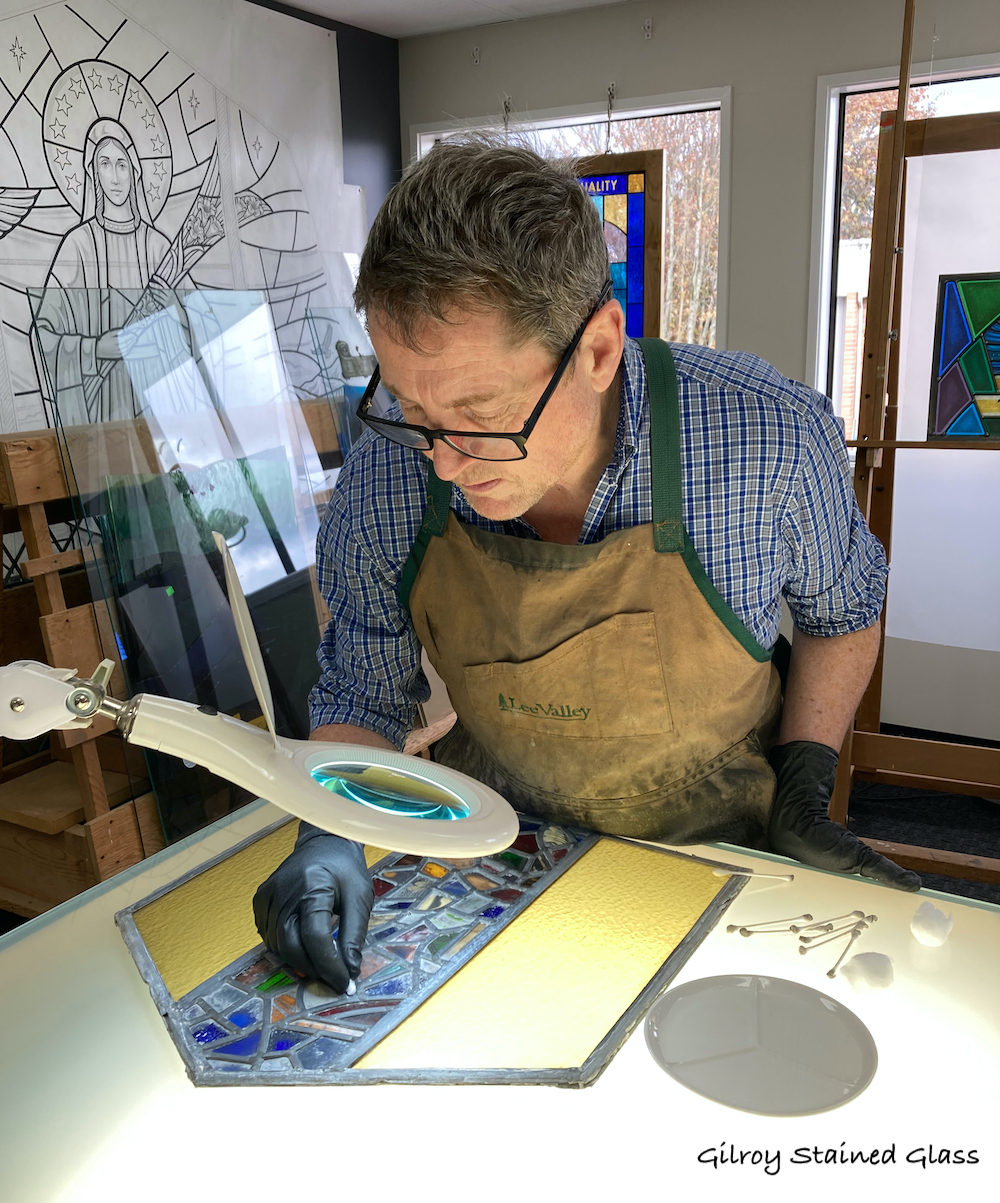
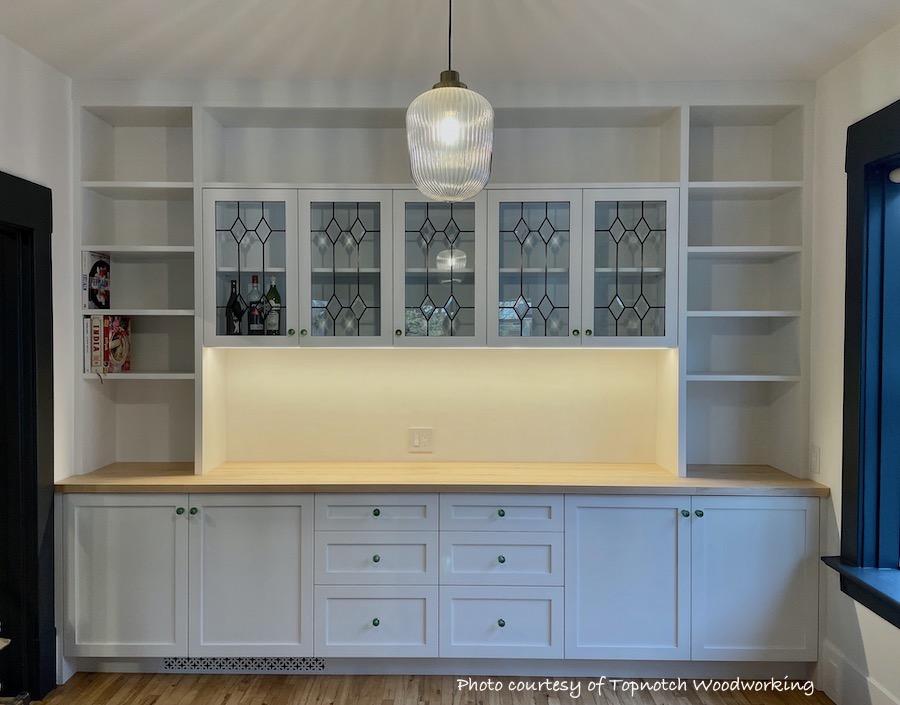
It was a natural progression in 2000 to become Gilroy Stained Glass and achieve their ambition of opening their own studio. They predominately supplied 30 other stained glass studios throughout Britain and the US with glass painting and artwork, as well as producing windows for a church furnishing company to export throughout the United States. They also undertook a variety of new commissions under their own studio name, ranging from residential and commercial projects through to ecclesiastical commissions for all religious denominations. They established a reputation as restoration experts, often called upon to meticulously restore windows so badly damaged that a box of fragments was the only clue left to its original state.
Laura, as the main designer, was elected an Associate of the British Society of Master Glass Painters (BSMGP) in 2000. The Gilroys also enjoy teaching glass painting classes, and feel that it is now their turn to pass on some of the skills and techniques which were once almost exclusive to the ecclesiastical artist.
They have developed a “taster” weekend course that manages to cover each stage of traditional glass painting, with all its joys - and, yes, - frustrations. Many students come back for follow on classes, and so the weekend course often runs on multi levels due to the differing skills of their students. The Gilroys both started drawing and painting early on, inspired by their parents; Laura’s father was a glass artist and John’s mother a keen painter in oils and acrylics. It was no surprise then that John and Laura chose to become artists themselves, but what they do find surprising is how their students often come to a love of drawing from the opposite direction; via their interest in stained glass and the realization of what they can create with practice.
Several of the design projects they completed for the US encompassed all the windows in a church, allowing them to set the artistic style and ambiance for the whole building. For an artist this is a very rewarding concept and one they wanted more opportunity to explore both in design and glass painting, and this led to the decision to move to North America where newer buildings increase this kind of opportunity. Their research, and Laura having family in Canada, led them in 2005 to Vancouver as a location where they could further their abilities and portfolio in a beautiful and stimulating environment.
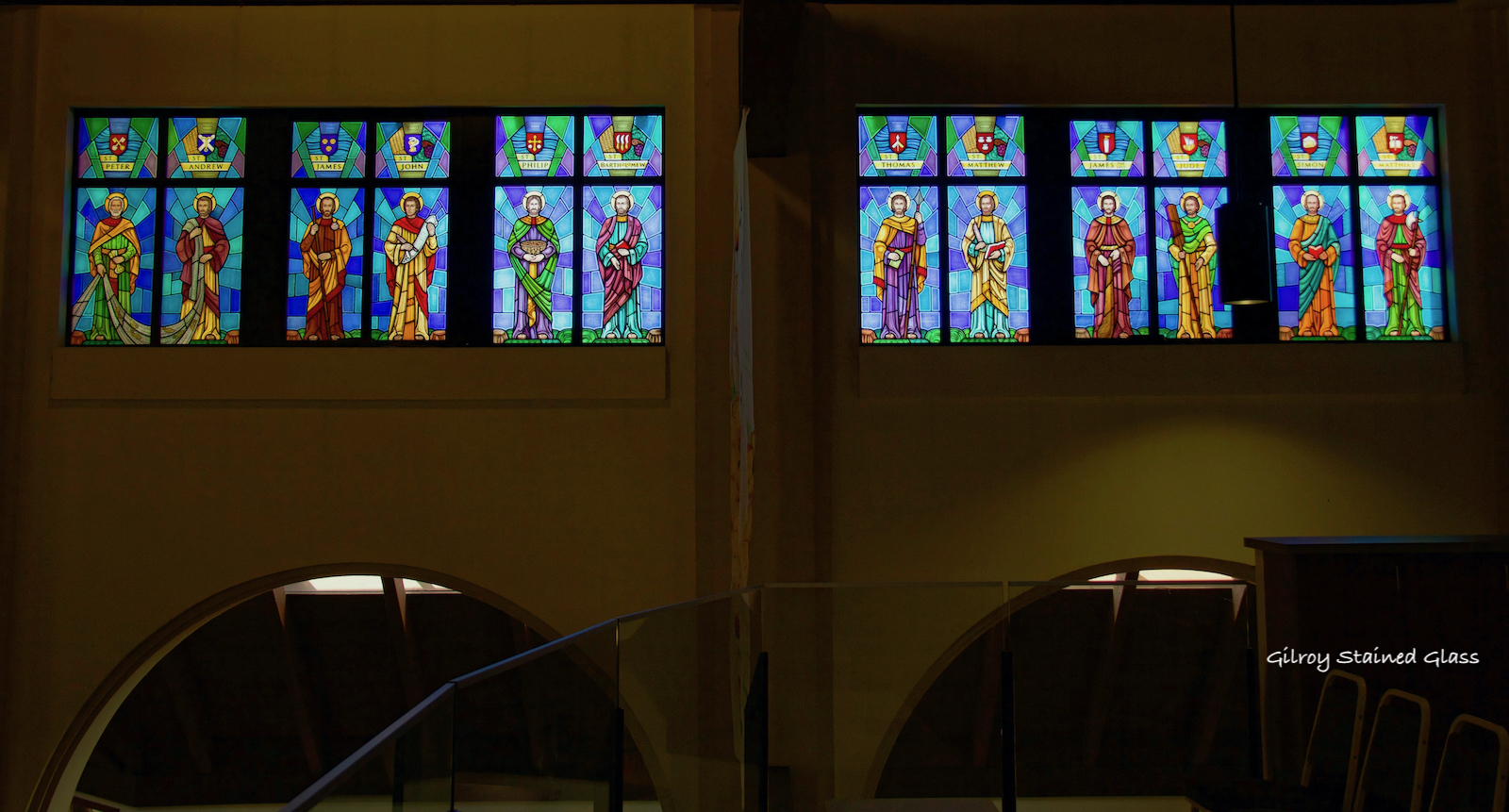
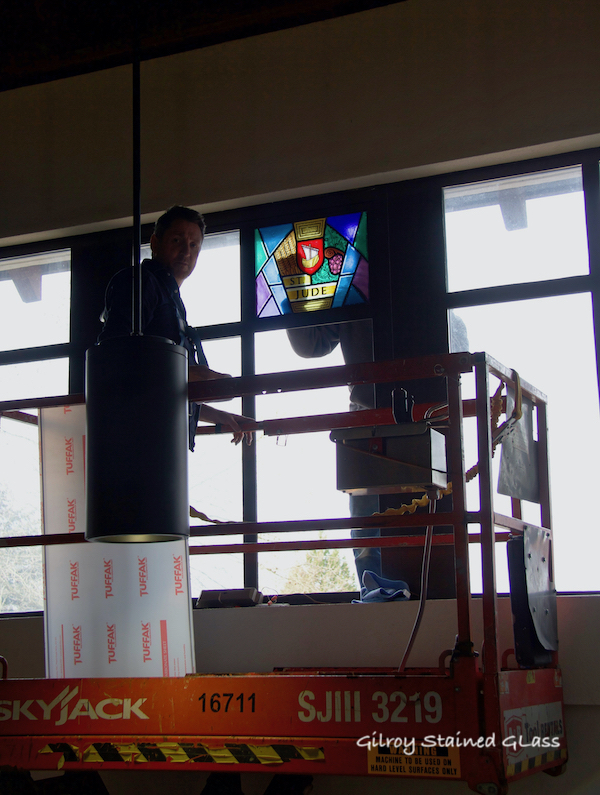
The Gilroys feel that there is greater potential to keep challenging their abilities here in North America, and believe they definitely made the right decision to relocate. As an example they are currently nearing the end of a rewarding 18 window project depicting the life of St. John the Apostle for a local Catholic Church. “By making a conscious effort to keep the studio focused on the fine art side of the craft; taking on projects that reflect this, and high standards of quality control at all stages including joinery and installation, really keeps the brain active.”
John feels that one of the most rewarding parts of his work is the further development of his painting techniques; “creating ‘Glassy’ painting which is sharp, jewel like and reads strongly from a distance, especially important for ecclesiastical work, brings a lot of satisfaction”. Laura maintains that for her “the conceptualization and design is the most exciting part of a project, but seeing the finished window installed in position runs a close second!”
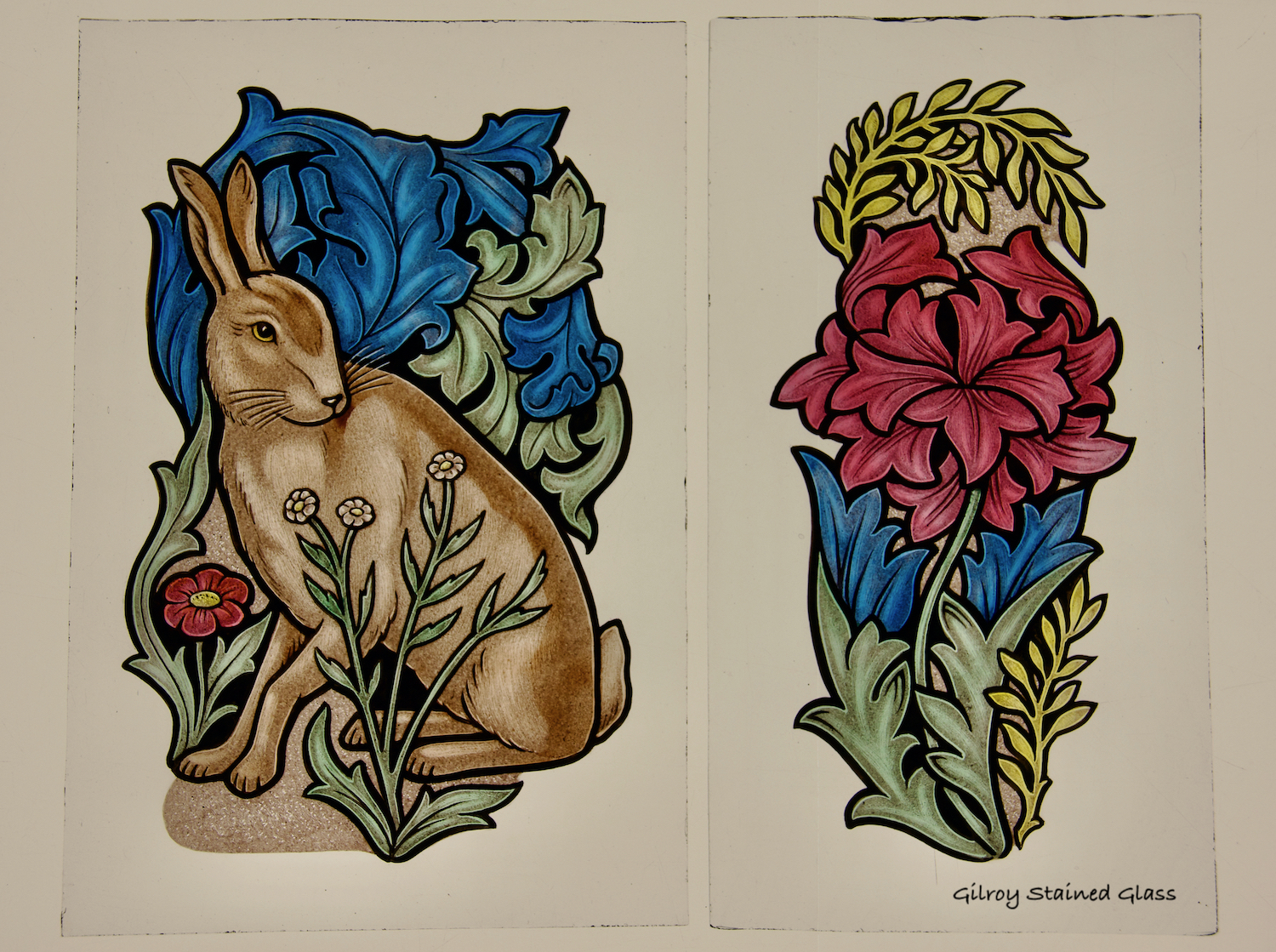
Gilroy Stained Glass specializes in traditional and contemporary glass painting and fabrication using materials of superior quality imported from all over Europe and North America. They believe that through good design, considered selection of glass and the application of painted tonal values an original piece of art that lends a special ambiance to its architectural surround can be created.”
Posted on October 26th, 2009
Tags: Classes, Design, painting, Restoration, Students, Technique
Categories: Published Articles | No Comments »
by John Gilroy
As it is World Mission Sunday this week (Oct 18th), we thought it would be interesting to blog a little about Blessed Joseph Allamano. He was named Pioneer of World Mission Sunday by Pope Paul VI and beatified by Pope John Paul II in 1990. Bl. Allamano was rector of the Turin shrine in Italy dedicated to Our Lady of Consolata, and he founded the Institute of Consolata Missionaries in 1901. The following year he sent four missionaries to Kenya, and today over 3,500 Consolata priests, brothers, sisters and volunteers serve in 25 countries.
We recently created a window for Holy Spirit Catholic Church, New Westminster, which celebrates the life and work of Bl. Allamano and the influence he had on the lives of so many people in many countries. From an artistic point of view, this was a particularly interesting project because Bl. Allamano is rarely depicted in stained glass yet his message of inclusion for all is so appropriate today in a world where so many people live in a country other than the one in which they were born.
Fr. David Hughes of Holy Spirit has this to say of Bl. Allamano and the stained glass window in a recent article in the BC Catholic newspaper: “Choosing him as the subject for our new window was appropriate; we have many of the ethnic groups in the window represented in our parish. One of our parishioners actually knew Bl. Allamano, and another was with the Consolata Missionaries in Africa. We have people from South America, Africa, and Asia, where the Consolata missionaries serve. The faces of the figures in the window are exceptional. The Gilroys did a masterful job on the expressions which, unlike what is seen in some stained glass, are very lifelike. The work is superb and we are thrilled.”
While we are on the subject of newsworthy links to stained glass projects at Holy Spirit church (tenuous, I know!), yesterday was the last day of the English tour of St. Therese of Lisieux’s relics. Coincidentally, it was also installation day for our St. Therese window at Holy Spirit. Many people, including the benefactor of this window, feel a great affinity with St. Therese and her “little way”. She is described as the “greatest saint of modern times” and her message of showing love through little deeds really resonates - as demonstrated by the 150,000 people who crowded to view the relics during the month long tour of England and Wales.

Posted on October 17th, 2009
Tags: Blessed Joseph Allamano, Mission Sunday, St. Terese of Lisieux
Categories: Window projects | No Comments »
by Laura Gilroy
Do I fire trace line and tonal applications separately?
We would advise beginners to start this way, firing your trace line first makes it easier to apply your tonal matt over the top and also allows margin for error in that you can always wipe off the matt and start again, without losing your trace line. More experienced artists may prefer to create their tonal effects first and then apply trace line over the top, but you need a sure and steady hand for that!
To what temperature do I need to fire paint?
Depending on your kiln, firing temperature for paint is between 680 - 720 degrees centigrade. When correctly fired the paint should have be smooth and slightly shiny. Fired too low, it will be “dry” with a slightly rough texture and it will be more difficult to clean off at the cementing stage. Different types of glass will fire better than others, generally mouth blown glass is “softer” and the paint will fuse more easily into the surface.
If I use transparent colour enamels, to what temperature do I fire, and do I apply before or after paint and stain?
Enamels are applied after the painting process and before stain. They usually come in powdered form and can be mixed on the palette with water and perhaps a tiny amount of gum Arabic to facilitate smoothing a largish area. They are applied on top of the paint in the area required, and can be painted on loosely with a brush as a water colour paint or applied as a matt and smoothed with a badger. If you want a smooth block colour it’s usually better to apply two thin layers over two firings. Firing temperature is a little lower than paint; 660 - 680 degrees centigrade, again depending on your kiln. As with ceramic enamels, the visual pigment of the colour can be different before fired than after and it looks opaque when applied, becoming transparent during firing. When you use a product for the first time, it’s always advisable to do test pieces on different glass and at different firing temperatures.
What is silver stain?
Stain is the process from which stained glass derives its name - legend has it that the happy accident of silver jewelry falling into a hot kiln with the glass during medieval times led to the discovery. Silver stain is silver nitrate within an opaque pigment used as a carrier. Stain is always applied to the back of the glass, turning the area to which it is applied yellow or amber. The carrier pigment is washed off after firing to reveal the (hopefully) perfect light amber glow beneath - very exciting!
To what temperature do I fire stain, and does it need to be placed face up or face down on the kiln shelf?
Stain should be fired face down on the kiln shelf. Students have told us that some glass painting manuals advocate firing stain face up, but there are a couple of reasons why we were taught as apprentices that this isn’t a good idea. First, if you fire the stain up then the paint side is down, and susceptible to picking up any possible missed debris or dust on your kiln shelf. Secondly, if you are used to placing the piece in the kiln stain down then you will not inadvertently be placing enamels face down - resulting in a very sticky mess on your kiln shelf and a ruined piece. Stain is the last process and is fired at a much lower temperature than paint; between 520 - 600 degrees centigrade depending on your kiln and, more importantly, on the glass you are using. The resultant hue of yellow can be controlled by how thickly the stain is applied, what temperature it is fired at (the higher the temperature the more amber the colour) and what type of glass is used. Again, do test pieces to fully determine and understand the achievable results. It’s also a good idea to have a separate kiln shelf for stain if possible, and certainly to have separate brushes as there must be no cross contamination with your paint.
Posted on September 5th, 2009
Tags: Add new tag, Enamels, frequently asked questions, Kiln firing, painting, silver stain, Students, Technique, Tonal details
Categories: Firing, Kiln fired enamels, Silver staining, Students, painting, questions and answers | No Comments »
by John Gilroy
Following our last posting we received requests for further information, so we thought we’d go over some of the questions that our students often ask us about glass painting. In future postings we’ll cover questions about silver stain, transparent enamels and firing temperatures.
Why do the tracing brushes need to be sable and so long?
Natural hair is still the best as it keeps its shape and holds a decent amount of paint. Sable is particularly “springy” allowing the painter to create a thin line with a light touch and a thicker one by applying slightly more pressure. We use #3 sign writer’s brushes which have hair approx 1 inch long with a pointed tip, excellent for expressive line work.
Badger brushes can be expensive, are the student versions ok to use?
A good quality professional badger matting brush can be considered an investment, as with proper care it will last a lifetime. It should be made of natural hair, for keeping its shape and having the correct give to it that allows smoothing and stippling of an area of paint being matted for tonal work. The hair should be approximately 3 inches long and about 3 inches wide, and most importantly, have about 3 rows of tufts of the hair in the base - this is what allows it to smooth without dragging. Student brushes have only 1 row of hair held rigidly at the base, and so they are best used for very small areas.
Why do I need to use a “bridge”?
A bridge is a piece of wood (or one of my favourites is made from thick transparent plastic) about 12 - 15 inches long with a block attached on either end to raise it 1½ inches above the table surface or light table. Its purpose is to be a surface on which to rest the hand and prevent the transfer of oils from the skin of the hands to the surface of the clean glass - water based paint will not flow properly on any oil spots. It’s also important for the artist’s hand to be a little elevated above the glass in order to allow for correct brush control and to prevent any accidental damage to completed sections. When we do tonal work on a vertical easel we use a mahl stick instead of a bridge - it does the same job.
I’ve seen paint labeled as “tracing black” and “matting brown”, what is the difference between the two?
We use the same high quality paint for both processes; we prefer a mid sepia brown as it’s neither too cold nor too warm in tone, unless it’s for restoration in which case the original paint colour must be matched. Some studios use a different paint for tracing and tonal application, in the past tracing paint was less finely ground, but if the same binder is used there is no need - the paint can be remixed on the palette with water and used for both. If a binder such as oil or acetic acid is used, the paint palettes must be kept separate.
What’s the best binder to use?
Gum Arabic is the most versatile binder, and can be used for both tracing and tonal applications. It’s easily obtained as a liquid from art stores - it comes in powder or crystal form also but is more difficult that way to control the potency of how much is added to the paint. We recommend trying 2 or 3 drops off the end of a tracing brush into a couple of tablespoons of paint on the palette, mix with water to a creamy consistency and test. The correct amount of gum for trace line is enough that the paint flows smoothly from the brush, but not so much that when the line is dry it is to hard to amend the line with a sharp stick or needle. A little more gum is usually needed for trace line; for tonal work we test to the “three strikes and you’re out” theory - the first light brush stroke takes off some paint, the second stroke takes it to a mid tone, and the third stroke takes the paint completely off the glass. Always test your paint - there’s nothing more annoying than matting a large project and then finding that the paint is too soft or too hard!
Posted on August 13th, 2009
Tags: Add new tag, brushes, frequently asked questions, painting
Categories: Students, painting, questions and answers | No Comments »
by John Gilroy
STAINED GLASS PAINTING
Stained glass painting by applying line and tone to white and coloured glasses has not changed in essence since Medieval times. Today, anyone who enjoys drawing and painting can try the techniques which were once almost exclusive to the ecclesiastical artist.
PAINT
The paint is a mixture of powdered glasses called fluxes, and ceramic pigments which fire at 1200F (700C) and fuse with the main pane of glass. If properly fired the paint will have a smooth sheen and be scratch resistant.
BINDERS
The powdered paint must be mixed with a binder to adhere it to the glass surface until fired. Most binders are water soluble and in addition help the paint to flow from the brush. Gum Arabic is the most versatile binder.
PALETTES
Sheets of glass on which to mix paint, possibly with a lid or saucer to cover paint when not in use.
PALETTE KNIFE
A flexible steel kitchen spatula 8″- 10″ long is best.
HAND REST/BRIDGE
A length of wood approx 15″x2″x1/2″ blocked up at each end to make a bridge and allow the hand to operate above the work. The only contact should be brushes and glass; finger marks will impair the flow of paint.
EASEL
A framed piece of plate glass set vertically with daylight behind or a light box which has been set vertically.
BEESWAX
A saucepan for heating beeswax to stick glass to easel plate.
TRACERS
The tracing brush is similar to a signwriter’s brush, but must have a good point. The long haired brush is best when made of sable because it springs back into position after being bent. Care of the tracer is important, it should never be left to harden in the paint or stand in the water jar as this may permanently damage the hairs.
MATTING BRUSH
Translucent washes are applied with soft haired flat brushes.
BADGER
This brush will last a lifetime with care, and is used to smooth matts or make stipples.
SCRUBS/HIGHLIGHTERS
Round and flat oil painters white hog hair brushes are used to remove dry paint by scratching strokes or stippling, leaving graduations of half tones. It is often necessary to trim new brushes to shape, then burn the end and rub on sand paper to refine the shape required.
STAIN
The process from which stained glass derives its name, silver stain is silver nitrate mixed with a pigment. When applied to the reverse of the glass and fired between 560-600C it turns the glass yellow (the higher the temperature the more amber the colour).
HOW TO PAINT

TRACING
- Mix 2 tablespoons of powdered paint with a couple of drops of gum Arabic and a little water in the centre of a palette and grind to a creamy paste. Collect with the palette knife and push paint to a corner of the palette, from this take small amounts to be further diluted in the middle of the palette as required.
- With a tracing brush filled with liquid paint start doodling freehand on a piece of clean glass to get a feel of the brush. If the paint doesn’t flow well, try diluting to a thinner fluid or adding a little more gum arabic.
- Next try placing a loaded brush on the glass, just touching enough to make a dot, then move the brush slowly to make a line - slightly lifting for a finer line and pressing slightly for a thicker line. Lines should be fluent and calligraphic in character.
- Avoid touching in or repainting lines after they have dried, as this will have adverse results when fired, also try to lay the paint as flat as possible as thick layers tend to flake.
- It is possible to modify lines after they have dried by scratching with a pointed stick or needle. Once satisfied with the linework, it is usual to fire the glass making it easier to work on the next painting stage.
PAINTING SHADING

- Mix the paint as previously described, and apply a wash with a matting brush in straight horizontal or vertical lines and badger smooth by lightly brushing in different directions. While the paint is still wet stipple it lightly with the tips of the badger hair.
- When the paint is dry test it with brushes, if it comes off too readily you may need more gum in the mix. Too much gum and the matt is too hard, somewhere in between is the right amount to suit.
- Using scrub brushes try making brush strokes in different directions, some lightly, some with pressure. Another method for removing the paint is pouncing or tapping with the end of a brush. Needles fixed into brush ends, pointed sticks, quills and anything which can be used to scratch lines or dots can be used.
- Traditional painting is basically a combination of stippling, brushing, rubbing and scratching. Bright highlights and edges can be picked out with a small brush, stick or needle.
- It should also be remembered that all paint applied to the glass is preventing light getting through, so aim to use paint to give a sparkling jewel-like quality to the glass without overpainting.
Posted on June 6th, 2009
Tags: Add new tag, brushes, painting
Categories: Firing, Process, Supplies, Tools, painting | No Comments »
by
Posted on
Categories: Uncategorized | No Comments »
by
Posted on
Categories: Uncategorized | No Comments »
by
Posted on
Categories: Uncategorized | No Comments »
by
Posted on
Categories: Uncategorized | No Comments »
by
Posted on
Categories: Uncategorized | No Comments »